Last week, I was teaching my neighbor how to crochet her first granny square, and she looked at me with complete confusion when I mentioned “chain 3, skip 2.” It hit me that what seems obvious to those of us who’ve been crocheting for years can feel like a foreign language to beginners. Understanding crochet abbreviations isn’t just about memorizing a list – it’s about unlocking the ability to follow any pattern with confidence.
I still remember my first pattern attempt. I stared at “sc in 2nd ch from hk” for about ten minutes, convinced the pattern had a typo. Spoiler alert: it didn’t. The problem was that I’d jumped straight into patterns without learning the basic abbreviation system that makes crochet instructions possible to write and follow.
Here’s what I wish someone had told me from the start: crochet abbreviations follow logical patterns, and once you understand the system, reading patterns becomes second nature. Most abbreviations are just shortened versions of the full stitch names, and the really tricky ones show up repeatedly, so you’ll memorize them faster than you think.
Whether you’re completely new to crochet or you’ve been avoiding certain patterns because the abbreviations look intimidating, this guide will walk you through everything you need to know. We’ll cover the essential abbreviations, the weird ones that trip everyone up, and practical tips for remembering them all.
Quick Answer
Crochet abbreviations are standardized shorthand for stitches and techniques, with basics like sc (single crochet), dc (double crochet), and ch (chain) forming the foundation. Most patterns use the same system, making them universal once you learn the key terms.
Essential Basic Abbreviations
Let’s start with the abbreviations you’ll see in almost every single pattern. These are your bread and butter, the ones that’ll show up whether you’re making a simple dishcloth or an intricate lace shawl.
ch stands for chain, and you’ll see this everywhere. It’s your foundation, your turning chains, your spaces between stitches. When a pattern says “ch 3,” you’re making three chain stitches. Simple enough, right?
sc means single crochet, the most basic stitch after the chain. It’s short, tight, and creates a dense fabric that’s perfect for amigurumi projects or sturdy household items.
dc is double crochet, which is actually the most common stitch in many patterns. It’s taller than single crochet and works up faster, making it ideal for blankets and scarves.
hdc represents half double crochet, sitting right between single and double crochet in height. I love using hdc for projects where I want a bit more drape than single crochet provides but don’t need the full height of double crochet.
sl st means slip stitch, often used for joining rounds or creating invisible seams. You’ll also see it written as “ss” in some patterns.
| Abbreviation | Full Name | Common Uses |
|---|---|---|
| ch | Chain | Foundation, turning chains, spaces |
| sc | Single Crochet | Dense fabric, amigurumi, edges |
| hdc | Half Double Crochet | Medium-height stitches, texture |
| dc | Double Crochet | Most common stitch, blankets, garments |
| sl st | Slip Stitch | Joining, finishing, invisible movement |
These five abbreviations will get you through probably 80% of beginner patterns. Once you’re comfortable with these, everything else builds on this foundation.
Common Stitch Abbreviations
Now let’s dive into the stitches that add texture, height, and interest to your projects. These show up frequently enough that you’ll want to memorize them, but they’re not quite as universal as the basics.
tr stands for treble crochet (also called triple crochet). This is a tall stitch that works up quickly and creates an open, drapey fabric. Perfect for lightweight summer tops or when you want to add height to your work quickly.
dtr means double treble crochet, which is even taller. You won’t see this as often, but it’s fantastic for creating dramatic height differences in textured patterns.
tch or t-ch represents turning chain. This is the chain or chains you make at the beginning of a row to bring your hook up to the correct height for the next row’s stitches.
blo and flo are game-changers once you understand them. BLO means “back loop only” and FLO means “front loop only.” Instead of working through both loops of a stitch (which is standard), you only work through one loop. This creates ridged textures and is essential for techniques like creating ribbed edges.
fpdc and bpdc represent front post double crochet and back post double crochet. These create raised stitches that pop forward or recede backward, perfect for cable-like textures and dimensional patterns.
Pro tip: When you see post stitches in a pattern, pay attention to whether you’re working in the round or in rows. The “front” and “back” change depending on which side you’re looking at.
Here are some texture-creating abbreviations you’ll encounter:
- bobble or bob – Multiple stitches worked in the same space and closed together
- popcorn or pc – Several complete stitches in one space, folded and closed
- puff – Multiple yarn overs pulled through together for a puffy effect
- cluster or cl – Multiple stitches worked together at the top
These texture stitches might seem intimidating, but they’re just combinations of basic techniques. Most patterns will include detailed instructions for special stitches, so don’t worry if you don’t memorize every variation.
Advanced and Special Technique Abbreviations
Once you’re comfortable with basic stitches, you’ll start encountering abbreviations for more advanced techniques. These might look scary at first, but they open up a whole world of interesting patterns and textures.
inc and dec are crucial for shaping. Inc means increase (making more stitches), and dec means decrease (reducing stitch count). In garment construction, these abbreviations help create curves and fitted shapes.
yo stands for yarn over, which is the motion of wrapping yarn around your hook. While this happens naturally in most stitches, sometimes patterns call it out specifically, especially in lace work.
sk or skip means to skip a stitch or space. This is super common in lace patterns and shell stitches where you’re creating deliberate gaps in your work.
tog means together, as in “sc2tog” (single crochet two together), which is a decrease technique. You’ll work into two stitches but only complete one stitch, effectively reducing your stitch count by one.
For colorwork and advanced shaping, you might see:
- CC – Contrasting Color (as opposed to MC for Main Color)
- RS – Right Side (the “public” side of your work)
- WS – Wrong Side (the back or inside of your work)
- rnd – Round (when working in circles)
- rep – Repeat
Lace patterns often include these specialized abbreviations:
- picot – Small decorative loop
- shell – Multiple stitches worked in the same space
- V-st – V-stitch (usually dc, ch, dc in same space)
Remember: Advanced abbreviations usually come with explanations in the pattern. Don’t feel like you need to memorize every possible abbreviation before starting more complex projects.
Understanding Pattern Symbols and Punctuation
Crochet patterns use specific punctuation and formatting that’s just as important as the abbreviations themselves. Getting comfortable with these conventions will make reading patterns much easier.
Parentheses ( ) group stitches that should be worked in the same stitch or space. For example, “(2 dc, ch 2, 2 dc) in corner space” means all those stitches go into that one corner space.
Brackets [ ] usually indicate a sequence that should be repeated. You might see “[dc in next st, ch 1, skip 1 st] 5 times” which means you repeat that entire sequence five times.
Asterisks * mark the beginning and end of repeat sections. “*Dc in next 3 sts, ch 2, skip 2 sts; rep from * across” tells you to repeat everything after the asterisk until the end of the row.
Semicolons separate different parts of instructions within the same step. They’re like taking a breath in the middle of a long sentence.
Commas separate individual stitches or small groups of stitches. “Sc, hdc, dc in next st” means you’re putting all three different stitches into that one stitch.
Numbers in patterns can be tricky too:
- Stitch counts are often shown in parentheses at the end of rows: (24 sts)
- Size variations might be shown as: “Ch 30 (35, 40, 45)” for different sizes
- Round numbers are usually written as “Rnd 3:” or “R3:”
When working with crochet charts and diagrams, you’ll encounter symbol-based patterns where each stitch type has a visual symbol rather than an abbreviation. These are especially common in international patterns and complex lace designs.
US vs UK Terminology Differences
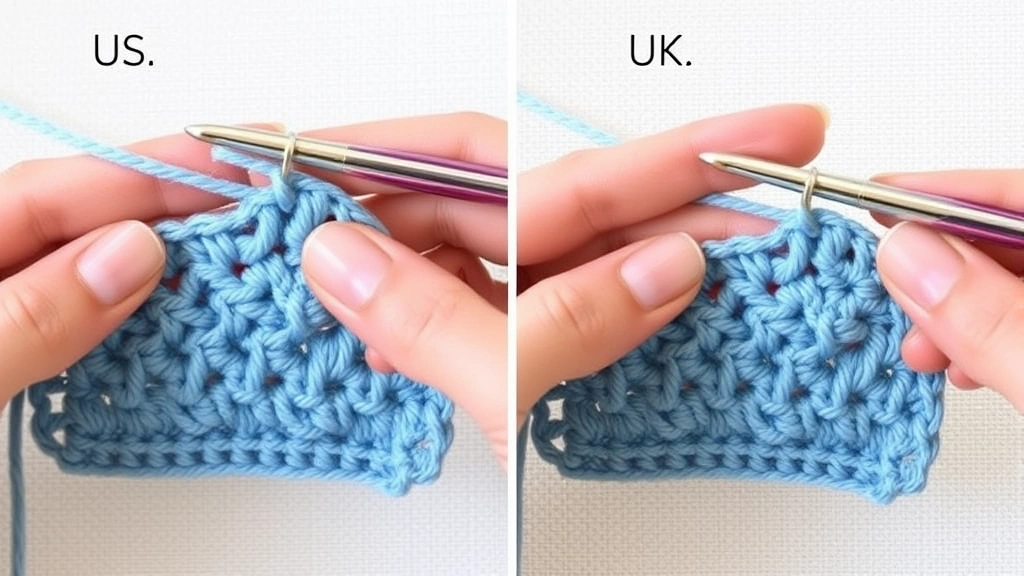
Here’s something that trips up a lot of crocheters: the same stitch names mean different things depending on whether you’re using US or UK terminology. This isn’t just academic – using the wrong terminology can completely change your finished project size.
The most important differences to know:
| US Term | US Abbreviation | UK Term | UK Abbreviation |
|---|---|---|---|
| Single Crochet | sc | Double Crochet | dc |
| Half Double Crochet | hdc | Half Treble Crochet | htr |
| Double Crochet | dc | Treble Crochet | tr |
| Treble Crochet | tr | Double Treble Crochet | dtr |
What makes this even more confusing is that UK patterns don’t have an equivalent to the US single crochet – their shortest stitch is what we call a single crochet, but they call it double crochet.
How can you tell which system a pattern uses? Look for these clues:
- Pattern source: US websites and books typically use US terms
- Yarn suggestions: US patterns often suggest US yarn brands
- Gauge information: US patterns use inches, UK patterns use centimeters
- Hook sizes: US patterns use US letter sizing (H, I, J) alongside mm
Most modern patterns will specify which terminology they’re using, but older patterns might not. When in doubt, check if the pattern mentions “single crochet” – if it does, it’s probably US terminology since UK patterns don’t typically use that term.
Safety tip: Always make a gauge swatch when trying a new pattern, especially if you’re unsure about the terminology. It’s much better to discover a sizing issue with a 4-inch square than with a half-finished sweater.
Tips for Memorizing Abbreviations
I get it – staring at a list of abbreviations can feel overwhelming. But here’s the thing: you don’t need to memorize every abbreviation before you start crocheting. The best way to learn them is through practice, and I’ve got some strategies that actually work.
Start with frequency. Focus on the abbreviations you’ll see most often. Chain, single crochet, double crochet, and slip stitch will get you through tons of patterns. Master these four, and you’re already ahead of the game.
Use the logical connections. Most abbreviations make sense when you think about them. “Hdc” is half double crochet – it’s literally half the height of a double crochet. “Blo” is back loop only – you’re only working in the back loop. These aren’t random letters; they’re shortcuts that follow patterns.
Practice with simple patterns. Choose beginner-friendly patterns that use lots of basic abbreviations. Dishcloths, scarves, and simple blankets are perfect for this. You’ll see “sc,” “dc,” and “ch” so many times that they’ll become automatic.
Keep a reference handy. I still keep a bookmark with common abbreviations in my project bag. There’s no shame in looking things up – even experienced crocheters encounter unfamiliar abbreviations in complex patterns.
Make it physical: Write out the full names while you’re learning. Instead of just reading “dc,” write “double crochet” a few times. The physical act of writing helps cement the connection in your memory.
Here are some memory tricks that work:
- Group by height: sc (short), hdc (medium), dc (tall), tr (taller)
- Think about the motion: “sl st” slides your hook through without adding height
- Use word associations: “inc” sounds like “increase,” “dec” sounds like “decrease”
- Practice saying them: Read patterns out loud using the full names instead of abbreviations
Don’t try to memorize everything at once. Learn abbreviations as you encounter them in patterns, and focus on understanding what each stitch does rather than just memorizing letter combinations.
Common Abbreviation Mistakes
Let me share some mistakes I’ve seen (and made) countless times. Knowing these common pitfalls will save you from frogging half a project because you misread an abbreviation.
Confusing “ch” spaces with stitches. When a pattern says “dc in next ch-1 space,” you’re working into the chain space, not the chain itself. But “dc in next ch” means you’re working into an actual chain stitch. This distinction matters a lot in lace patterns and shell stitches.
Missing the difference between “around” and “in.” “Sc around post” means you’re working around the vertical post of a stitch, while “sc in st” means you’re working through the top loops normally. Post stitches create completely different textures and require different techniques.
Skipping turning chains. Some patterns count turning chains as stitches, others don’t. Pay attention to whether the pattern says “ch 3 (counts as dc)” or just “ch 3.” This affects your stitch count and can throw off your entire project.
Mixing up increases and decreases. “Sc2tog” means you’re decreasing (making two stitches into one), while “2 sc in next st” means you’re increasing (making one stitch into two). These look similar written out but do opposite things to your stitch count.
Here’s how to avoid these mistakes:
- Read the entire pattern first
Don’t jump straight into crocheting. Read through the whole pattern, including any special notes or stitch explanations. Many patterns define their abbreviations at the beginning.
- Check your stitch count
Most patterns give stitch counts at the end of rows or rounds. Use these to catch mistakes early rather than discovering problems after several rows.
- Pay attention to punctuation
Commas, semicolons, and parentheses aren’t just decoration – they group instructions and show you exactly where each set of stitches should go.
- When in doubt, look it up
The Craft Yarn Council maintains a comprehensive list of standard abbreviations. Bookmark it and use it.
Remember, most abbreviation mistakes are fixable. If something looks weird or your stitch count is off, stop and double-check the abbreviations before continuing. It’s much easier to fix a mistake early than to redo several rows of work.
Common Questions
Do I need to memorize all abbreviations before starting my first project?
Not at all! Start with basic abbreviations like ch, sc, dc, and sl st. Learn new ones as you encounter them in patterns. Most beginners can complete simple projects knowing just 5-10 common abbreviations. Focus on understanding what each stitch does rather than memorizing every possible abbreviation.
What’s the difference between US and UK crochet terms?
The main difference is that UK terms are generally one step “taller” than US terms. A US double crochet is called a treble crochet in UK terminology. US single crochet equals UK double crochet. Always check which system your pattern uses, as using the wrong terminology will change your finished size significantly.
Why do some patterns use different abbreviations for the same stitch?
While most abbreviations are standardized, some designers use variations or older conventions. For example, you might see “ss” instead of “sl st” for slip stitch, or “tr” called “trc” for treble crochet. Context usually makes the meaning clear, and most patterns include an abbreviation key.
How do I know if a pattern is using US or UK terminology?
Look for clues like the pattern source (US vs UK website), yarn suggestions (US vs UK brands), measurements (inches vs centimeters), and hook sizes (US letters vs UK numbers). US patterns typically mention “single crochet,” while UK patterns don’t use this term since they don’t have an equivalent stitch.
What does it mean when abbreviations are in parentheses or brackets?
Parentheses ( ) group stitches that go in the same place, like “(2 dc, ch 2, 2 dc) in corner.” Brackets [ ] usually indicate repeats, such as “[dc, ch 1, skip 1] 5 times.” Asterisks * mark longer repeat sections. This punctuation is just as important as the abbreviations themselves for understanding patterns.
Are there abbreviations I should prioritize learning first?
Yes! Focus on ch (chain), sc (single crochet), dc (double crochet), hdc (half double crochet), sl st (slip stitch), inc (increase), dec (decrease), and rep (repeat). These eight abbreviations appear in probably 90% of beginner to intermediate patterns and will get you through most projects.
What should I do if I encounter an abbreviation I don’t recognize?
First, check if the pattern includes an abbreviation key or special stitch instructions – many patterns define unusual abbreviations. If not, look it up on the Craft Yarn Council website or Ravelry’s stitch dictionary. When working on complex patterns, keep a reference list handy rather than trying to memorize every possible abbreviation.
Do abbreviations change for different types of projects like amigurumi or garments?
The basic abbreviations stay the same, but you’ll encounter specialized terms for different project types. Amigurumi patterns often use “magic ring” or “mr” for starting rounds. Garment patterns include shaping abbreviations like “inc” and “dec” more frequently. Lace patterns have their own set of specialized abbreviations for complex stitch combinations, but the fundamentals remain consistent across all project types.
Learning crochet abbreviations might seem daunting at first, but remember that every experienced crocheter started exactly where you are now. I still remember the satisfaction of reading my first pattern without constantly referring to an abbreviation chart – it felt like cracking a secret code.
The key is to start with simple patterns and build your abbreviation vocabulary gradually. Don’t worry about memorizing everything at once. Focus on the basics, use patterns that match your current skill level, and keep a reference handy for the abbreviations you haven’t memorized yet.
Most importantly, don’t let unfamiliar abbreviations stop you from trying new patterns. The crochet community is incredibly helpful, and there are countless resources available when you need help decoding a tricky abbreviation. Before you know it, you’ll be reading complex patterns as easily as you read a recipe.
Happy crocheting, and remember – every expert was once a beginner who didn’t give up!